- Who We Serve
- What We Do
- About Us
- Insights & Research
- Who We Serve
- What We Do
- About Us
- Insights & Research
Summary
SKOR provides investment grade U.S. corporate bond exposure using a forward looking view of credit risk.
Rather than weighting issuers by debt outstanding, the strategy emphasizes quality and value characteristics tied to issuer fundamentals.
The result is a disciplined approach to corporate credit designed to pursue income while allocating risk more intentionally.
What is SKOR and why was it created?
SKOR is an investment grade U.S. corporate bond ETF designed to help investors pursue income while taking a more forward looking view of credit risk. It was developed in response to the limitations of traditional corporate bond indexes, which typically rely on issuer debt size and legacy credit ratings rather than issuer fundamentals
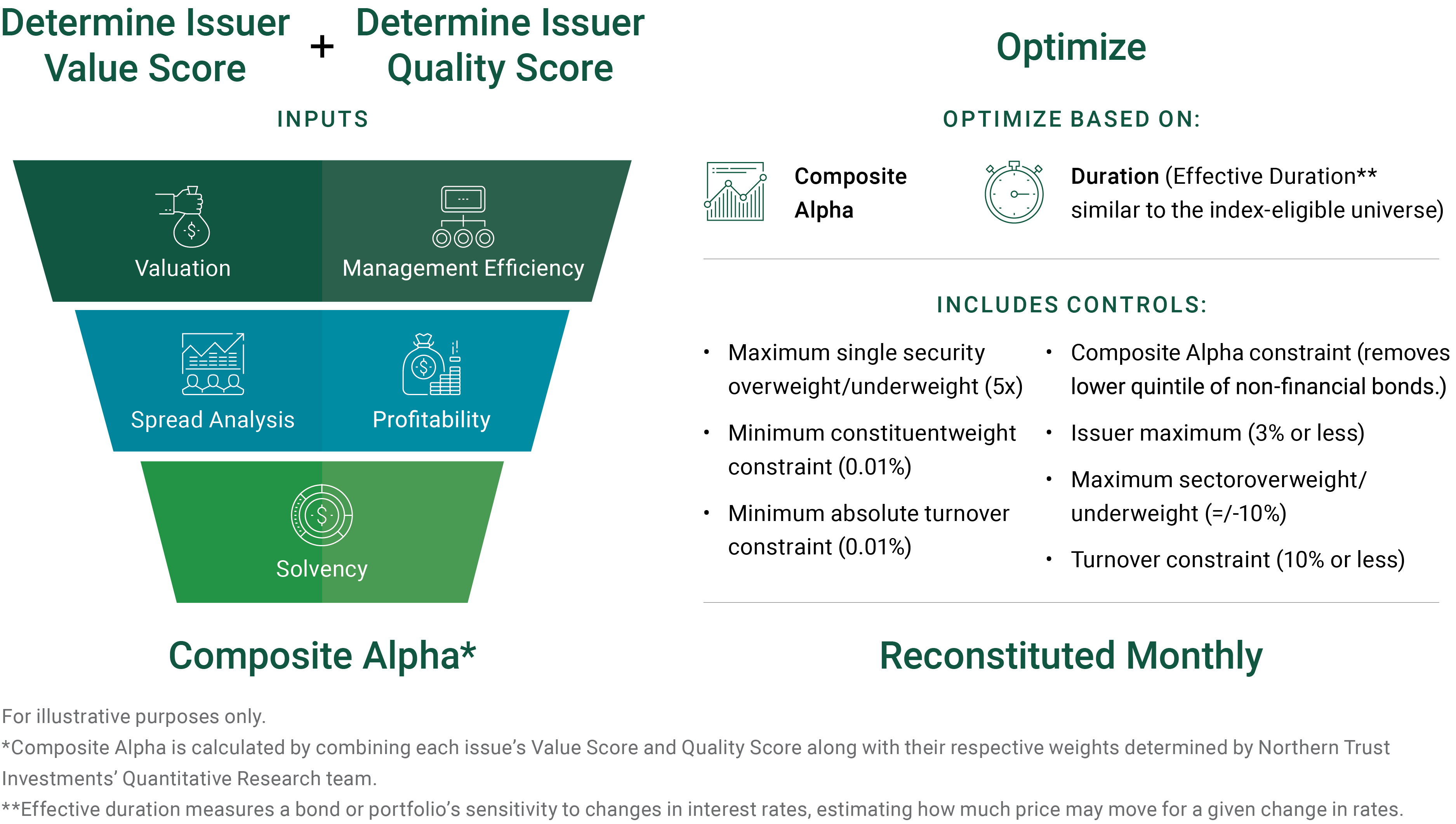
SKOR tracks the Northern Trust US Corporate Bond Quality Value Index, which applies a systematic quality and value based framework to security selection and weighting. The objective is to maintain broad exposure to intermediate maturity corporate bonds while emphasizing issuers with stronger balance sheets, healthier profitability, and more attractive valuations.
How does SKOR differ from traditional investment grade corporate bond ETFs?
Most traditional corporate bond ETFs weight issuers by the amount of debt outstanding. That approach can increase exposure to the most indebted companies, regardless of underlying financial strength. SKOR takes a different approach by evaluating issuers on forward looking quality and value characteristics before determining portfolio weights.
By incorporating measures such as solvency, profitability, management efficiency, and relative valuation, SKOR seeks to allocate credit risk more deliberately. This approach is designed to improve diversification and reduce reliance on credit ratings alone when assessing issuer risk.
What does “credit scored” mean in practice?
“Credit scored” refers to the index’s use of a quantitative framework that evaluates issuers using multiple quality and value inputs, rather than depending solely on credit agency ratings. Each eligible issuer receives both a Quality Score and a Value Score, which are combined into a composite signal used in portfolio construction.
The intent is to provide a more nuanced, forward looking assessment of issuer strength and potential credit deterioration, while maintaining exposure to the investment grade corporate bond universe.
How does SKOR manage interest rate and duration risk?
SKOR is structured to maintain an effective duration profile similar to the broader intermediate maturity investment grade corporate bond market. Duration is treated as a constraint, not an active source of risk.
This allows the strategy to focus on issuer selection rather than interest rate positioning, helping SKOR function as a core corporate bond allocation without introducing unintended duration bets relative to traditional benchmarks.
What role do quality and value play in a corporate bond portfolio?
In corporate bonds, quality and value can influence both downside protection and return potential. Issuers with stronger financial profiles may be better positioned during periods of economic stress, while bonds trading at more attractive valuations can offer improved risk adjusted income over time.
SKOR seeks to balance these forces by emphasizing issuers that demonstrate financial resilience while avoiding overpaying for perceived safety. The goal is not necessarily to maximize yield, but to pursue income efficiently relative to the risks taken.
How does SKOR seek to control concentration and diversification?
The index underlying SKOR applies multiple diversification and risk controls, including limits on issuer weights, sector deviations, and turnover. These controls are designed to prevent excessive concentration in any single issuer or industry while maintaining broad exposure across the corporate bond market.
By combining systematic issuer selection with disciplined portfolio constraints, SKOR seeks to deliver diversified corporate credit exposure without drifting into unintended risks.
How should advisors think about SKOR relative to active corporate bond strategies?
SKOR sits between traditional passive and fully discretionary active corporate bond strategies. While it follows a rules‑based index, the methodology reflects active insights into credit quality, valuation, and risk management. This provides access to a systematic, repeatable framework for issuer selection without relying on manager discretion or tactical calls, while still moving beyond simple debt‑weighted indexing.
Where does SKOR typically fit in a portfolio?
SKOR is most often used as a core investment grade corporate bond allocation within a broader fixed income sleeve. It can serve as a complement or alternative to traditional market value weighted corporate bond ETFs for investors seeking a more fundamentals aware approach to credit exposure.
Advisors may also pair SKOR with government, securitized, or municipal bonds to balance income generation and credit risk across client portfolios.
Contact Us
Interested in learning more about our expertise and how we can help?
IMPORTANT INFORMATION
Before investing, carefully consider the FlexShares investment objectives, risks, charges and expenses. This and other information is in the prospectus, a copy of which may be obtained by visiting www.flexshares.com. Read the prospectus carefully before you invest.
Foreside Fund Service, LLC, distributor. FlexShares and Foreside are not related.
FlexShares Credit -Scored US Corporate Bond Index Fund (SKOR) is passively managed and uses a representative sampling strategy to track its underlying index. Use of a representative sampling strategy creates Tracking Risk where the Fund’s performance could vary substantially from the performance of the underlying index along with the risk of high portfolio turnover.
As with any investment, you could lose all or part of your investment in a FlexShares ETF, and the ETF’s performance could trail that of other investments. An ETF is subject to certain risks, including the principal risks notes below, any of which may adversely affect the ETF’s net asset value (“NAV”), trading price, yield, total return and ability to meet its investment objective.
For more complete information on the Fund’s Principal Risks, please read the prospectus and summary prospectus, including all principal risk information such as: Concentration Risk (Financial Sector), Income Risk, Credit (or Default) Risk, Interest/Maturity Risk and other principal risks. Copies of the prospectus and summary prospectus may be obtained by visiting www.flexshares.com. Read the prospectus carefully before you invest.
Corporate Bond Risk is the risk the Fund faces because it invests primarily in bonds issued by corporations. Quality-Value Score Risk is the risk that the Fund’s investment in companies whose securities are believed to be undervalued will not appreciate in value as anticipated or the past performance of companies that have exhibited quality characteristics does not continue. Authorized Participant Concentration Risk is the risk that the Fund may be adversely affected because it has a limited number of institutions that act as authorized participants. Market Trading Risk is the risk that the Fund faces because its shares are listed on a securities exchange, including the potential lack of an active market for Fund shares, losses from trading in secondary markets, periods of high volatility and disruption in the creation/redemption process of the Fund. ANY OF THESE FACTORS MAY LEAD TO THE FUND’S SHARES TRADING AT A PREMIUM OR DISCOUNT TO NAV.
© 2026 Northern Trust Corporation. Head Office: 50 South La Salle Street, Chicago, Illinois 60603 U.S.A.